How to Choose a Force Free Dog Trainer You Trust
- 11 minutes ago
- 5 min read
A trainer can teach your dog to sit, but the way they teach matters just as much as the result. When you are learning how to choose a force free dog trainer, you are choosing the kind of relationship you want to build with your dog: one based on safety, trust, clear guidance, and a shared enjoyment of life together.
Force-free training is not about letting dogs do whatever they want. It is structured, thoughtful teaching that helps dogs understand what to do, practise it in manageable steps, and feel good about getting it right. For a worried puppy, a boisterous adolescent, or a dog who barks and lunges on walks, that difference can shape both learning and emotional wellbeing.
Start with the trainer's methods, not the marketing
Many trainers use words such as “positive,” “balanced,” “humane,” or “relationship-based.” Those words can mean different things from one business to another. The clearest approach is to ask directly how the trainer responds when a dog makes a mistake, ignores a cue, or reacts strongly to another dog or person.
A genuinely force-free trainer teaches desired behaviours with rewards, play, food, access to things the dog enjoys, and carefully planned practice. They manage the environment so your dog is not repeatedly pushed over their comfort threshold. They may use a harness, long line, treat pouch, toys, gates, or visual barriers, but they will not rely on fear, pain, or intimidation to get compliance.
Be specific when you ask about tools. A trainer committed to pain-free learning will not recommend or use shock collars, prong collars, choke chains, leash corrections, alpha rolls, ear pinches, spray bottles, or harsh verbal intimidation. They should be comfortable explaining that position without making you feel foolish for asking.
There is an important distinction here: a dog can look quiet or obedient after a correction, yet still be frightened, shut down, or uncertain about what will happen next. Training should not merely stop behaviour in the moment. It should give your dog a safe, workable alternative and help them feel more capable in the situations they find difficult.
Ask how the trainer handles real-life challenges
The right questions reveal far more than a list of credentials. If your dog pulls, jumps, barks at visitors, steals food, or struggles around other dogs, describe the situation honestly and ask what the first few sessions might look like.
A force-free professional will usually want to know what happens before the behaviour, how often it occurs, what your dog is communicating, and what makes the situation easier or harder. They may talk about distance, management, enrichment, rest, gradual exposure, and building skills before expecting your dog to cope in a challenging setting.
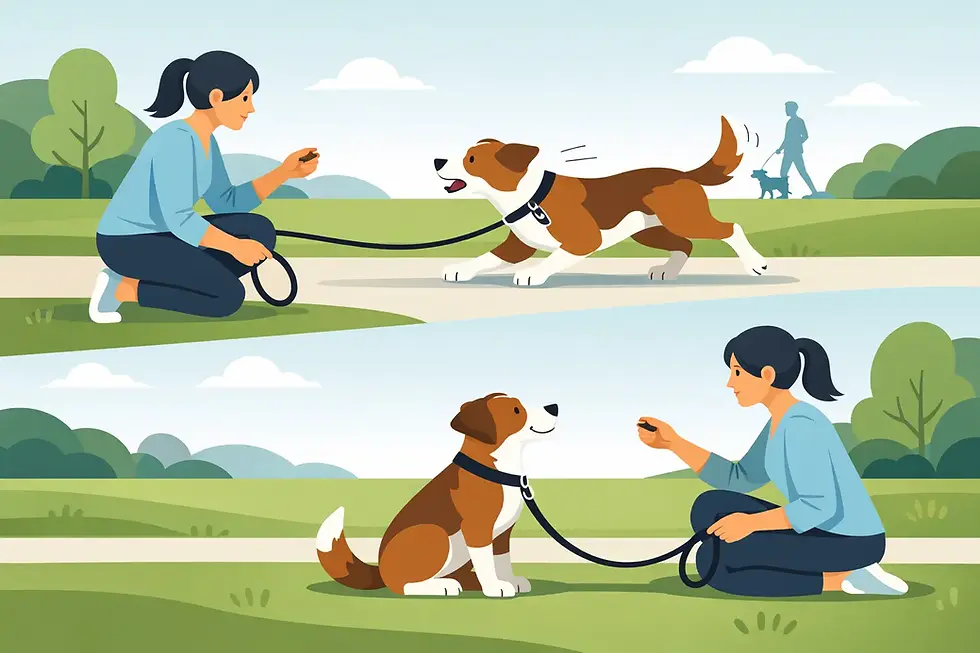
For example, a dog who lunges at other dogs does not need to be forced closer until they “get used to it.” A thoughtful trainer may begin at a distance where that dog can still notice another dog, take food, and respond to their person. From there, the dog can learn that seeing a trigger predicts support and good things, rather than pressure or punishment.
Ask these questions in a conversation or consultation:
What do you do if my dog is scared, barking, or unable to focus?
Which training tools do you use, and which ones do you not use?
How will you help my dog learn an alternative behaviour?
What can I do at home between sessions?
How do you adjust the plan if my dog is struggling?
A good trainer will not promise a quick fix before meeting your dog. Behaviour is influenced by health, history, environment, genetics, daily routine, and the skills a dog has had time to practise. Honest support includes realistic expectations and a plan that can adapt.
Look for skill, continuing education, and humility
Dog training is not a single regulated profession in Canada, which means titles alone do not guarantee a trainer's knowledge or methods. Certifications and formal education can be useful signs that someone has invested in learning, but they are only one part of the picture.
Look for a trainer who can clearly explain their approach in everyday language. They should understand that behaviour has an emotional component, recognize when pain or health concerns may be affecting a dog, and refer clients to a veterinarian or qualified behaviour professional when needed.
Experience matters too, especially if your dog has more than a basic manners concern. A trainer who is wonderful with puppy socialization may not be the best fit for serious reactivity, separation-related distress, or a history of biting. There is no shame in needing specialized help. In fact, a trainer who recognizes the limits of their scope is demonstrating professionalism and care.
You are not looking for someone who claims to have all the answers. You are looking for someone who observes closely, listens well, keeps learning, and treats both dogs and people with respect.
Watch a class or session before you commit
If possible, observe a group class, either in person or through an unedited video. Watch the dogs as much as the instructor. Do they appear eager to participate? Are they given enough space? Can they take breaks, sniff, move away, or work at an easier level if the environment becomes too much?
A well-run class is not necessarily silent. Puppies may wiggle, dogs may bark occasionally, and owners may need help. What matters is how the instructor responds. Look for calm coaching, practical set-ups, and an atmosphere where people are not embarrassed for having a normal dog who is still learning.
Class size and layout matter, too. Some dogs thrive in a lively group, while others need more space, a quieter setting, or private lessons before they are ready. Ask how many dogs attend, whether barriers or distance are available, and what happens if your dog needs an individual adjustment.
The same principle applies to board-and-train services. If a trainer cannot explain exactly what will happen to your dog when you are not present, or will not allow you to observe their methods, choose another option. Your dog deserves transparent care.
Choose support that works for your whole household
The best plan is one your family can actually carry out. A trainer may offer excellent ideas, but they should fit your schedule, your dog's age and energy level, your home environment, and the people who share responsibility for the dog.
For a new puppy, that may mean a class focused on positive socialization, handling, recall, settling, and confidence around everyday sights and sounds. For an adolescent dog, it might mean practising loose-leash walking, polite greetings, impulse control, and calmness around distractions. For an adult dog with emotional distress, private lessons may offer a safer place to begin.
Ask what support is included after a class or lesson. Clear written exercises, realistic homework, and the chance to ask follow-up questions can make a substantial difference. Training is not about performing perfectly in front of an instructor. It is about creating small, repeatable successes at home, on walks, and in the places your dog needs to live their best life.
Trust what the first conversation tells you
You should leave an initial conversation feeling heard, not blamed. A supportive trainer will make room for your concerns, whether you are overwhelmed by puppy biting, frustrated by barking, or worried that your dog's behaviour is getting worse. They will not tell you that you must dominate your dog, become “the boss,” or accept a painful tool as the only answer.
They also will not judge you for what has happened before you found them. Most people are doing their best with the information they have. Force-free training gives you a kinder path forward, with skills that make sense for dogs and people alike.
For Nanaimo families seeking structured, pain-free support, Best Paw Forward Dog Training centres every lesson on motivation, emotional safety, and practical everyday progress. The goal is never just a dog who obeys. It is a dog who feels safe learning beside you.
Choose the trainer who helps you see your dog more clearly, celebrates progress in small steps, and gives you both room to grow. That is where lasting change begins.